AWS Certification Career Path: From Beginner to Cloud Professional
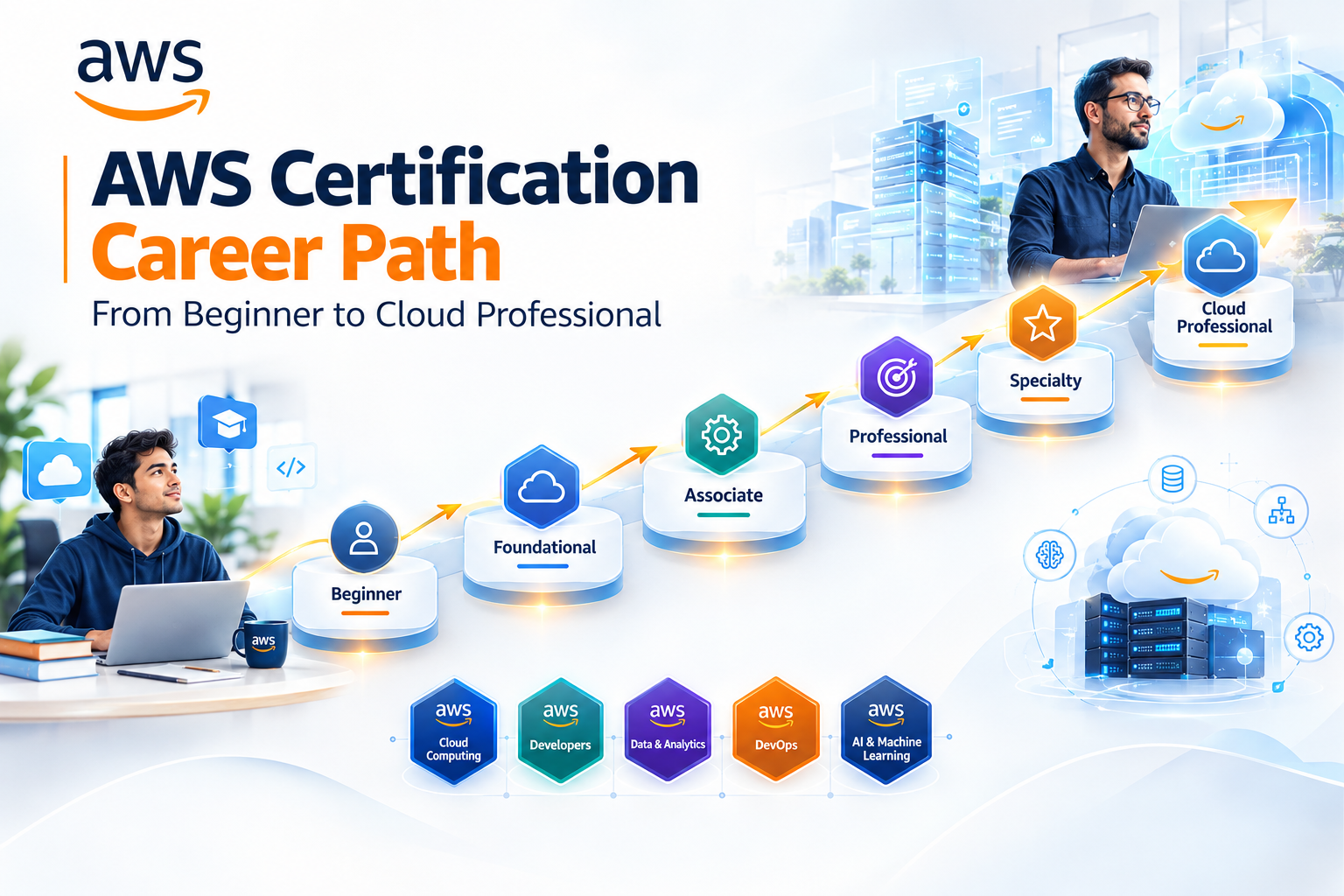
Cloud computing has become an important part of modern IT, and Amazon Web Services (AWS) remains one of the most widely used cloud platforms. For professionals looking to move into cloud computing, AWS certifications can provide a structured way to learn cloud concepts, validate technical knowledge, and build toward specific cloud roles.
But there is one common question among beginners:
Where should I start with AWS Certification?
You don't necessarily need to jump directly into an advanced certification. AWS provides different certification levels that can help learners progress from foundational knowledge to specialized and professional-level expertise.
In this guide, we'll explore an AWS certification career path from beginner to cloud professional, including the major certification levels, popular career directions, and how to choose the right path.
What Is the AWS Certification Career Path?
The AWS certification ecosystem is designed around different levels of cloud and technical expertise.
The current certification structure includes:
Foundational Associate Professional Specialty
AWS also has a business-focused certification category, including its AI Business Strategist certification. The certification site encourages candidates to choose a path based on the role they currently have or want to pursue.
A simplified career progression looks like this:
Beginner → Foundational → Associate → Professional / Specialty → Advanced Cloud Career
However, this doesn't mean every professional has to complete every level.
Your ideal path depends on your background, experience, career goal, and technical interests.
Step 1: Start With Cloud Fundamentals
If you're completely new to cloud computing, building a strong foundation should be your first priority.
AWS Certified Cloud Practitioner
The AWS Certified Cloud Practitioner is a foundational certification designed to validate high-level knowledge of AWS Cloud, services, and terminology.
AWS describes it as a suitable starting point for people with no prior IT or cloud experience, including professionals transitioning toward cloud careers.
You can use this stage to understand concepts such as:
Cloud computing AWS global infrastructure Core AWS services Security fundamentals AWS pricing and billing Cloud architecture basics Shared responsibility model Basic AWS terminology Who should consider it?
Cloud Practitioner can be particularly useful for:
Beginners Fresh graduates Non-IT professionals moving toward cloud Project managers Product professionals Sales and business professionals IT professionals who want to establish cloud fundamentals
AWS currently categorizes Cloud Practitioner as a Foundational certification, with no prior experience required.
What comes next?
Once you understand cloud fundamentals, you can move toward an Associate-level certification based on your desired role.
Step 2: Choose Your AWS Career Direction
This is where your AWS certification journey becomes more career-focused.
Instead of asking:
“Which AWS certification is the easiest?”
Ask:
“Which AWS role do I want to build toward?”
AWS's certification strategy increasingly emphasizes role-based paths. Its current Associate-level certifications include Solutions Architect, Developer, Data Engineer, CloudOps Engineer, and Machine Learning Engineer.
Here are some popular directions.
Career Path 1: AWS Solutions Architect
If you enjoy designing systems and understanding how different cloud services work together, the Solutions Architect path can be a strong option.
Recommended direction:
Cloud Fundamentals → Solutions Architect – Associate → Solutions Architect – Professional
The Associate certification focuses on designing distributed systems on AWS and applying AWS architectural principles.
You should develop knowledge of:
Compute Storage Networking Databases Security Scalability High availability Cost optimization AWS Well-Architected principles
As your experience grows, you can progress toward the Professional level.
Career Path 2: AWS Developer
If your background is in software development, the AWS Developer path may be more relevant.
A possible progression is:
Cloud Fundamentals → Developer – Associate → DevOps / Professional-level expertise
The AWS Certified Developer – Associate validates technical proficiency in developing, testing, deploying, and debugging AWS Cloud-based applications.
Important areas include:
AWS SDKs APIs Application deployment Serverless development Databases Monitoring Security CI/CD Application troubleshooting
This path can be particularly relevant for developers who want to move from traditional application development toward cloud-native development.
Career Path 3: AWS Cloud Operations
Cloud platforms need professionals who can deploy, operate, monitor, and troubleshoot workloads.
For this direction, AWS currently offers the AWS Certified CloudOps Engineer – Associate certification.
A simplified path is:
Cloud Fundamentals → CloudOps Engineer – Associate → Advanced Operations / DevOps
Skills to develop include:
AWS infrastructure Monitoring Deployment Automation Security Networking Troubleshooting Operational best practices
This path can be relevant for professionals coming from systems administration, infrastructure, operations, or related technical backgrounds.
Career Path 4: AWS Data Engineering
Cloud and data engineering increasingly overlap.
For professionals interested in building data pipelines and managing data workloads, AWS offers the AWS Certified Data Engineer – Associate.
AWS describes this certification as validating skills related to data models, data lifecycle management, and data quality.
A possible roadmap is:
Cloud Fundamentals → Data Engineer – Associate → Advanced Data / Analytics Expertise
You should develop knowledge of:
Data storage Data pipelines Databases Data processing Data integration Data quality Analytics Security AWS data services Career Path 5: AWS Machine Learning and AI
AI is becoming increasingly important within cloud careers.
AWS now has certifications covering foundational AI knowledge as well as technical machine learning skills.
For beginners, AWS Certified AI Practitioner validates foundational knowledge of AI, machine learning, and generative AI concepts on AWS.
For technical professionals, AWS Certified Machine Learning Engineer – Associate focuses on implementing, deploying, and maintaining AI and ML solutions on AWS.
A possible path is:
Cloud Fundamentals → AI Practitioner → Machine Learning Engineer – Associate → Advanced AI/ML Expertise
This can be particularly interesting for professionals who want to combine:
Cloud + AI + Machine Learning
rather than focusing on traditional cloud infrastructure alone.
Step 3: Build Hands-On AWS Skills
One mistake beginners make is treating certification preparation as a memorization exercise.
AWS certification should ideally be combined with practical experience.
You should learn by actually working with cloud services and understanding how they behave in real scenarios.
For example, while studying AWS architecture, you might explore:
Launching cloud resources Configuring storage Creating databases Setting up networking Managing permissions Monitoring workloads Deploying applications Designing highly available architectures
AWS itself recommends combining learning resources with hands-on practice, including labs and other practical learning experiences.
Certification + Practice = Stronger Learning
Think of the journey like this:
Learn → Practice → Build → Test → Certify
rather than:
Memorize → Take Exam → Forget
Step 4: Move Toward Professional-Level Expertise
Once you've developed significant AWS experience, you can consider Professional-level certifications.
AWS currently describes Professional certifications as validating advanced AWS skills and lists Solutions Architect – Professional and DevOps Engineer – Professional among its Professional certifications.
Professional-level preparation requires a deeper understanding of:
Complex architectures Large-scale systems Security Reliability Performance Cost optimization Automation Troubleshooting Multi-service AWS environments
AWS currently recommends 2+ years of AWS experience for its Professional certification level.
The important point is that Professional certification should generally be treated as an experience-driven milestone, not simply the next exam to take immediately after becoming certified.
Step 5: Consider AWS Specialty Certifications
Specialty certifications are useful when you want to demonstrate deeper expertise in a particular AWS technology or domain.
AWS currently lists Specialty certifications such as AWS Certified Security – Specialty and AWS Certified Advanced Networking – Specialty.
Specialty areas can be useful for professionals who want to develop deeper expertise in areas such as:
Security Networking Advanced cloud architecture Specialized technical domains
A potential path could look like:
Associate → Professional → Specialty
But again, there is no universal requirement to follow this exact order.
Your career goal should determine your certification strategy.
AWS Certification Career Roadmap at a Glance
Here's a simplified view of the journey:
            AWS CLOUD CAREER
                   │
                   ▼
          Cloud Fundamentals
                   │
                   ▼
        AWS Foundational Level
         ┌─────────┴─────────┐
         │                   │
 Cloud Practitioner    AI Practitioner
         │                   │
         └─────────┬─────────┘
                   ▼
            Associate Level
                   │
   ┌───────────────┼────────────────┐
   │               │                │
Architect Developer Data Engineer │ │ │ ├────────── CloudOps ─────────────┤ │ └──── Machine Learning Engineer │ ▼ Professional Level │ │ ▼ ▼ Architect DevOps │ ▼ Specialty Expertise │ ▼ Advanced Cloud Career
The exact path should be customized according to your role and experience.
How to Choose the Right AWS Certification
Before selecting a certification, ask yourself five questions.
- What is my current experience?
Are you:
A complete beginner? An IT professional? A developer? A system administrator? A data professional? A cloud engineer?
Your starting point matters.
- What role do I want?
Think about your target job rather than only the certification name.
For example:
Want to design cloud systems?
→ Solutions Architect
Want to develop cloud applications?
→ Developer
Want to manage cloud workloads?
→ CloudOps
Want to work with cloud data?
→ Data Engineer
Want to build AI/ML solutions?
→ Machine Learning Engineer
- Do I have hands-on experience?
If you're targeting Associate or Professional certifications, don't rely entirely on theoretical preparation.
Build practical AWS skills alongside your exam preparation.
- What technology area interests me?
Cloud careers are broad.
You could eventually specialize in:
Architecture | Development | Operations | Data | AI/ML | Security | Networking
- What is my long-term career goal?
Don't choose a certification simply because it is popular.
Choose one that moves you closer to the role you want.
AWS Certification Is Not the Same as AWS Career Experience
This distinction is important.
An AWS certification can help validate knowledge and skills, but certification alone doesn't replace practical experience.
A strong cloud professional typically develops three components:
- Knowledge
Understanding AWS services and cloud concepts.
- Hands-On Skills
Actually building and operating solutions.
- Certification
Demonstrating validated knowledge through an industry-recognized credential.
Think of it as:
Knowledge + Practice + Certification = Stronger Cloud Profile
How Long Does the AWS Certification Journey Take?
There is no single timeline that works for everyone.
Your timeline depends on:
Existing IT experience AWS exposure Weekly study time Certification level Hands-on practice Technical background Career goal
A beginner might first focus on foundational cloud concepts, while an experienced IT professional may be ready to move directly toward an Associate certification.
AWS itself notes that candidates can start from different points depending on their background, current role, and desired career path.
So don't compare your timeline with someone else's.
Focus on building skills progressively.
AWS Certification Preparation Strategy
A practical preparation cycle can look like this:
Step 1 — Understand the certification
Read the official exam guide and understand the exam domains.
Step 2 — Learn the concepts
Build your understanding of AWS services and architectural principles.
Step 3 — Practice
Use hands-on labs and practical exercises.
Step 4 — Review
Identify weak areas and revisit the relevant AWS services.
Step 5 — Practice questions
Use realistic exam-style questions to understand how concepts are tested.
Step 6 — Assess readiness
Take practice assessments before scheduling your exam.
AWS's own Cloud Practitioner preparation plan follows a similar progression: understand the exam, refresh knowledge and skills, review and practice, and assess exam readiness.
Don't Stop After Your First AWS Certification
One AWS certification can be a starting point rather than the end of your learning journey.
AWS currently provides benefits to certified professionals, including a 50% discount voucher for a future AWS Certification exam and a digital badge that can be used to showcase certification status.
You can use your first certification to identify your next skill gap.
For example:
Cloud Practitioner
↓
Solutions Architect – Associate
↓
Solutions Architect – Professional
↓
Security / Networking / Data specialization
This creates a continuous learning cycle.
AWS Certifications and the Future of Cloud + AI
Cloud careers are evolving.
AI, generative AI, automation, data engineering, security, and cloud infrastructure are increasingly interconnected.
AWS's current certification ecosystem reflects this shift by including foundational AI certification, machine learning certification, and microcredentials covering areas such as agentic AI, serverless, application networking, and incident response.
This means future cloud professionals may need more than traditional infrastructure knowledge.
A modern cloud career could increasingly combine:
Cloud + AI + Data + Automation + Security
Professionals who continuously update their skills can position themselves for emerging technology roles.
AWS Certification Career Path: The Big Picture
There isn't one AWS certification roadmap that everyone should follow.
A beginner might start with:
Cloud Practitioner → Associate → Professional
A developer might follow:
Cloud Fundamentals → Developer – Associate → Advanced Cloud Development / DevOps
A data professional could pursue:
Cloud Fundamentals → Data Engineer – Associate → Advanced Data Expertise
An AI-focused professional could consider:
AI Practitioner → Machine Learning Engineer – Associate → Advanced AI/ML Skills
The key is to choose a path based on where you are today and where you want your career to go.
Final Thoughts
AWS certification can be a useful part of a cloud career strategy, but the strongest approach is not to collect certifications randomly.
Instead:
Choose a career goal.
Build the required cloud skills.
Practice with real AWS technologies.
Earn the certification that validates your knowledge.
Continue developing toward your next role.
Whether you're starting from zero or already working in IT, the AWS certification ecosystem gives you multiple entry points and career directions.
The goal isn't simply to become AWS Certified.
The bigger goal is to become a skilled cloud professional who can solve real-world technology problems.
If you're planning your AWS learning journey, start by identifying your target role and then work backward to the skills and certification that support it.
FAQs:
1. Is AWS Certification good for beginners?
Answer: Yes. AWS currently positions Cloud Practitioner as a foundational certification for people who are new to cloud and may have little or no prior IT experience.
2. Which AWS certification should I take first?
Answer: For beginners with limited cloud experience, Cloud Practitioner is a common starting point. IT professionals with relevant experience may be able to begin with an Associate certification instead. AWS recommends choosing based on your background and target career path.
3. Can I get an AWS certification without IT experience?
Answer: Yes. AWS states that no prior experience is required for its Foundational certifications, including Cloud Practitioner and AI Practitioner.
4. Should I get Cloud Practitioner before Solutions Architect Associate?
Answer: Not necessarily. Cloud Practitioner can help beginners establish foundational knowledge, but experienced IT professionals may choose to start directly with an Associate certification depending on their background.
5. Which AWS certification is best for developers?
Answer: AWS Certified Developer – Associate is designed to validate skills related to developing, testing, deploying, and debugging AWS Cloud-based applications.
6. Which AWS certification is best for AI professionals?
Answer: AWS currently offers AI-focused options at different levels. AI Practitioner is designed around foundational AI, ML, and generative AI concepts, while Machine Learning Engineer – Associate validates technical skills for implementing, deploying, and maintaining AI/ML solutions on AWS.
7. Does AWS certification expire?
Answer: AWS certifications generally have validity periods, and AWS has introduced additional recertification options. In June 2026, AWS announced that eligible professionals can maintain a certification for an additional year by completing selected training and hands-on labs through AWS Skill Builder rather than retaking the full certification exam.
8. Is AWS certification enough to get a cloud job?
Answer: Certification can help demonstrate validated knowledge, but it should be combined with hands-on experience, projects, problem-solving ability, and relevant technical skills.
Start Building Your AWS Career
The AWS certification journey doesn't have to be complicated.
Start with your career goal, identify the skills you need, choose the appropriate certification level, and build practical experience along the way.
Beginner → Foundational → Associate → Professional / Specialty → Cloud Career
Your first certification is not the destination.
It's the beginning of your cloud career journey.